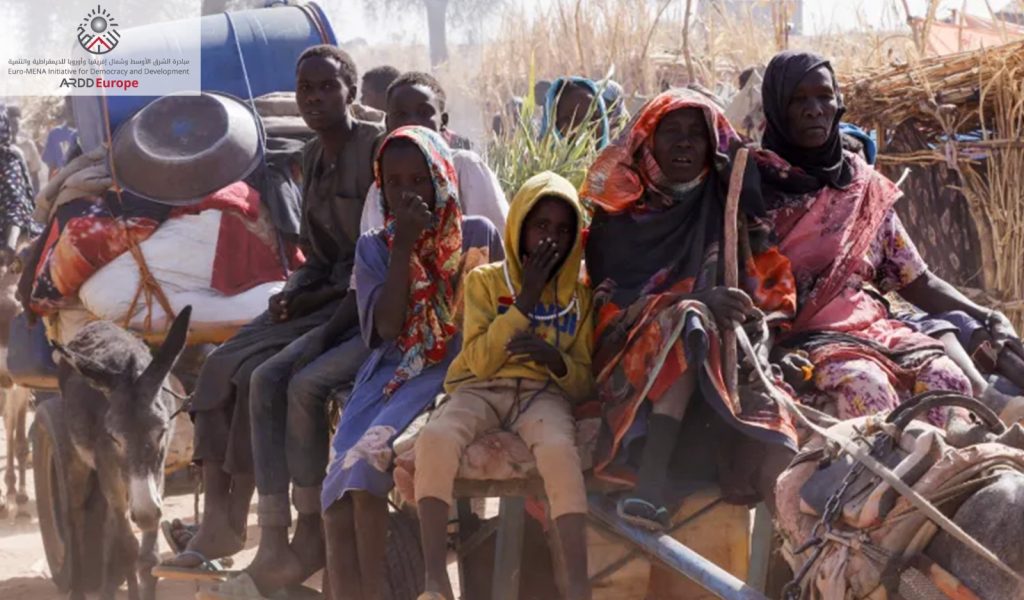
The Euro-MENA Initiative for Democracy and Development – ARDD Europe expresses its grave alarm at the unfolding atrocities in El Fasher, North Darfur, where the seizure of the city by the Rapid Support Forces (RSF) has resulted in devastating loss of life, widespread displacement, and the destruction of civilian infrastructure.
We echo and build upon the urgent appeal issued by the European Council on Foreign Relations (ECFR): the war in Sudan is not simply a distant conflict, it is a geopolitical emergency with profound implications for Europe, the Arab region, and global justice.
The crisis in Sudan is not an isolated breakdown but the culmination of long-standing systemic failures: cycles of militarization, impunity, and regional interference. The disintegration of the Sudanese state exposes a fragile political order upheld by external interests and sustained neglect. Sudan’s tragedy mirrors broader patterns of collapse and abandonment seen from Yemen to Gaza, where entire populations are subjected to mass killings, forced displacement, and systematic dispossession.
This is not the spontaneous failure of one state but a regional unraveling rooted in colonial legacies, militarized economies, and a geopolitical architecture that prioritizes containment and control over justice and transformation. These violent crises are not disconnected “conflicts,” but symptoms of a system that normalizes oppression as an instrument of rule.
Across the Arab region, Sudanese refugees already live in extremely precarious conditions, often marginalized and excluded from protection mechanisms or durable solutions. The renewed escalation of violence risks abandoning these communities entirely, leaving them further behind, stranded without safety, and forgotten by the international community.
This deepening crisis highlights the urgent need for a new approach to Euro-Arab cooperation. The destinies of the two regions are profoundly intertwined. Instability and displacement in one reverberate across the other, while the erosion of the rule of law, the rise of militarized economies, and the shrinking of civic space reveal shared vulnerabilities. The cost of inaction will not only be borne by Sudan but will reverberate across borders—through the expansion of human suffering, irregular migration, and the erosion of the very principles of justice and humanity.
Four Priorities for Euro-Arab Action
The Euro‑MENA Initiative calls on governments, institutions, and multilateral partners to take immediate, principled action on the following fronts:
- Protect civilians
- Demand an immediate halt to RSF hostilities against civilians
- Use diplomatic channels (including UN Security Council, the Arab League, and EU foreign policy instruments) to guarantee humanitarian access, ceasefire enforcement, and civilian evacuation corridors.
- Investigate and halt arms flows
- As ECFR highlights, European states must demand full transparency on arms shipments to Sudan, including end-user certificates, cargo manifests, and flight records.
- Sanction all entities and individuals involved in weapons transfers, gold trafficking, or financing war crimes.
- Strengthen support to the UN Panel of Experts on Sudan and the Fact-Finding Mission, and condition diplomatic and security cooperation on regional actors’ compliance with investigations.
- Expand refugee protection and resettlement pathways in the EuroMediterranean region
- As of 26 October 2025, over 11.7 million Sudanese have been forcibly displaced by the war. Europe and the MENA region must scale up protection for these populations, beginning with Sudanese populations in bordering countries.
- Launch special humanitarian corridors and family reunification schemes, and expand resettlement and protection programming for Sudanese asylum-seekers.
- Scale-up predictable funding for host communities and agencies to deliver access to legal identity, education, health care, housing, and livelihood opportunities.
- Reframe Euro-Arab cooperation toward justice and accountability
- The ECFR correctly notes that European policy has defaulted to “containment and accommodation.” This must change. Europe and Arab states must shift toward frameworks that prioritize civilian protection, post-conflict reconstruction, and inclusive governance, not militarized deterrence.
- Align all aid, trade, and migration partnerships with strict human rights conditionality and support for transitional justice, local civil society, and democratic processes.
Europe’s credibility, and the very meaning of its partnership with the Arab world, should reinforce and prove the willingness to confront the moral and political foundation of violence that define our time. The people of Sudan—and of the wider region—cannot wait for the next atrocity to remind us of our shared responsibility.