By Giulia Zorzo
EMI-ARDD Liaison Focal Point
Amman | Rome
Europe has been a destination for migrants for decades, yet it has struggled to manage arrivals and, above all, to integrate the people who come. Since the so-called “refugee crisis” of 2015, EU Member States repeatedly tried, with small success, to renew their common policy towards migration. The result is the Pact on Migration and Asylum, officially applied in all Member States in June 2026. Brussels presented it as a common solution that is “effective, fair, and firm”, combining tighter external borders, solidarity between states and faster asylum and returns procedures.
The Pact reflects a broader securitisation of migration policy, shaped by the rise of far-right and populist parties and the pressure they exert. Years of economic insecurity, growing political disengagement and declining trust in institutions allowed right-wing parties to capitalize on the anger of people, often addressing marginalised groups as the responsible for social issues. Anti-immigrant sentiments now feature predominantly in public debate, led by populist politicians amplifying identitarians anxieties and presenting irregular migrations and border security as the major issue for Europe. From Italy to Germany, France, and Sweden, and more, elections have shown the success of this strategy, while mainstream forces have increasingly adopted more restrictive approaches to mitigate the concerns of the electorate.
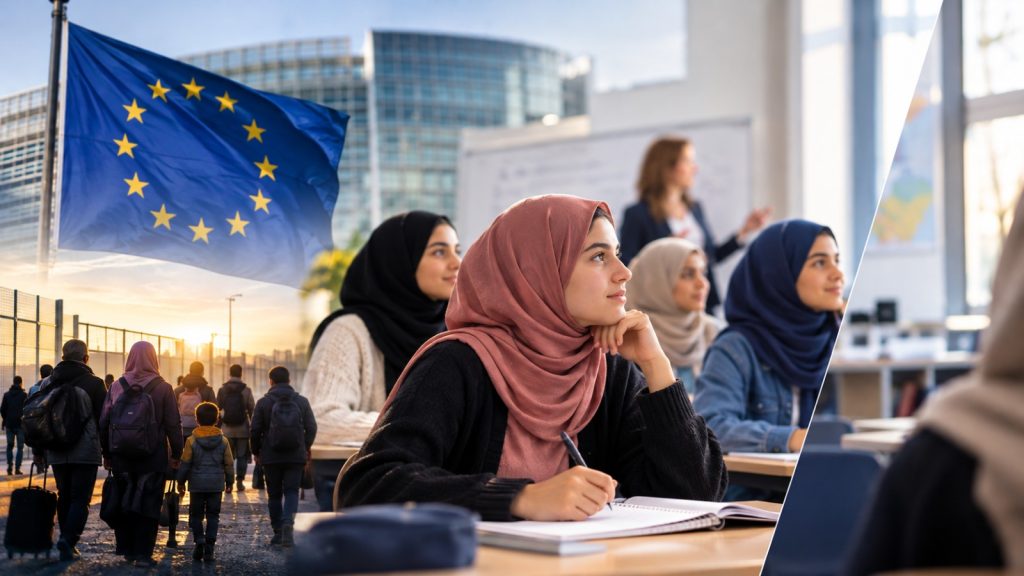
It is against this political backdrop that Italy’s latest school decree should be understood. Approved in September 2026, the measure has been presented as a 30% cap on foreign students in classrooms and a ban on niqab and burqa. As expected, it has immediately attracted significant attention both in Italy and abroad.
Critics described it as a mere propagandistic move aimed at appealing to the far-right electorate, ahead of the 2027 general election. That is itself a problem. A government that expects to win consensus with measures that exclude a minority, even when framed in moderate, integration-oriented terms, shows how the political climate has polarized and that a part of the Italian electorate rewards signals of exclusion.
The content of the decree
The decree’s content covers more points than those mainly reported by news, including the introduction of new school subjects, changes to high school qualifications, and free Italian classes for parents of foreign students.
Concerning the 30% cap, the decree does not target foreign students as such. The criteria are language skills and time spent in Italian education, two elements that, as declared by the Minister of Education Giuseppe Valdiatra, are “essential to ensure integration and fruitful participation in class”. In detail, in primary schools it applies to kids who are not Italian citizens, were not born in Italy and have not attended a minimum of two years of preschool, while in secondary schools it refers to non-Italian citizens who have not completed at least three years of school in Italy.
The role of language as a gateway to integration is not a novelty in Europe. France and Germany use reception classes (UPE2A and Willkommensklassen), where newly arrived students are taught the local language intensively before fully joining regular classes. The Netherlands funds schools according to students’ needs. Schools with many pupils lacking Dutch receive extra funds for language support, tutoring and inclusion programmes. Denmark is closest to Italy’s approach. When a school exceeds a threshold of students needing language support, students are relocated to schools with a higher-percentage of Danish speaker students. Austria represents a cautionary case, where separate German-support classes have generated institutional discrimination and significant learning delays for students attending them.
These examples demonstrate that the central question is not whether language support is necessary, but rather how that support is provided. A policy that addresses language barriers can promote integration and offer newly arrived students the instruments to participate equally in education, but it can also become a barrier if language skills become the criteria for separating children from their peers.
Nonetheless, the measure that probably generated the most immediate reaction is the ban on burqa and niqab, partly due to confusion over terms. Many reacted believing that the ban concerned what is called “hijab”, the headscarf most commonly worn by Muslim girls and women in classes and in everyday life. Burqa and niqab, instead, are two traditional islamic veils that cover the whole face.
Similar bans already exist in public spaces in other European countries, among these France, Belgium, Austria, and more. Supporters typically justify such measures on the grounds of security, identification, public order and gender equality. At the same time, restrictions on religious costumes raise concerns around freedom of religion and the risk of disproportionately affecting Muslim women.
The European Legal Framework fighting Discrimination
Even though education remains a national competence, Italy’s decree cannot escape scrutiny under European Law. All Member States’ national measures concerning migrants and minorities must regularly comply with European and international human rights standards.
The EU Treaties prohibit discrimination on grounds of nationality and the Charter of Fundamental Rights guarantees the right to education.
On top of that, the EU’s Action Plan on Integration and Inclusion 2021-2027 acknowledges the risk of discrimination and inequality in education and promotes measures to avoid it, including language learning. However, this is an instrument of soft law that cannot compel any state to act, but only sets a common direction.
Therefore, European countries have quite wide freedom to choose their own measures, but always within the limits of law. In practice, the line between legitimate language policy and discrimination is often drawn in the details of how a rule is written and applied. Rules that do not mention nationality can still be discriminatory if, in practice, they fall overwhelmingly on individuals of foreign origin.
Conclusion
Behind all the propaganda and the debate, these measures directly affect the lives of people, often already in vulnerable positions and fragilely included in the society, not by choice but because of the barriers they face.
In Italy and across all Europe, where migration is a defining feature, integration remains central to building societies on strong ties. Knowing the language of the place where you live is certainly fundamental to that process. However, this cannot be forced with fines and bans. Migrants, asylum seekers, and refugees need meaningful opportunities to participate in the society in which they live, through education, labour, and access to social and political life. Their ability to contribute to receiving society is determinant for social cohesion and for the long-term prosperity of Europe itself.
References
Awaken Nomad. (2025, March 7). The myth of Denmark’s “best education system” and the reality for multilingual kids. Medium. https://medium.com/@awakennomad/the-myth-of-denmarks-best-education-system-and-the-reality-for-multilingual-kids-2d4f30336051
De Leo, C. (2026, September 24). Dal CDM via libera al testo alle nuove norme sulla scuola| tetto di stranieri nelle prime classi, no al burqa e Corsi d’italiano per genitori. Meloni: Evitiamo Classi-Ghetto. Schlein: Decreto Vergogna, Caccia alle Streghe Su Pelle dei Bambini. Corriere Della Sera. https://roma.corriere.it/politica/diretta-live/26_settembre_24/decreto-scuola-tetto-stranieri-classe-consiglio-ministri.shtml
EUR-Lex. (n.d.-a). Treaty on the Functioning of the European Union. Official Journal 115 , 09/05/2008 P. 0056 – 0056;. Retrieved 4 October 2026, from https://eur-lex.europa.eu/LexUriServ/LexUriServ.do?uri=CELEX:12008E018:EN:HTML
EUR-Lex. (n.d.-b). CHARTER OF FUNDAMENTAL RIGHTS OF THE EUROPEAN UNION. Europa.Eu. Retrieved 4 October 2026, from https://eur-lex.europa.eu/legal-content/EN/TXT/HTML/?uri=CELEX:12012P/TXT#d1e32-393-1
European Commission. (2020). Action plan on Integration and Inclusion 2021-2027. https://www.euro-access.eu/_media/file/123_Action_Plan_on_Integration_and_Inclusion_2021-2027.pdf
European Commission. (2024, May 21). Pact on Migration and Asylum. European Commission. https://home-affairs.ec.europa.eu/policies/migration-and-asylum/pact-migration-and-asylum_en
France 24. (2026, September 26). Austria ‘ghetto’ language classes leave children to repeat school. FRANCE 24. France 24. https://www.france24.com/en/live-news/20260926-austria-ghetto-language-classes-leave-children-to-repeat-school
Government of the Netherlands. (2014, October 27). Tackling educational disadvantage at secondary school. Government.Nl. https://www.government.nl/themes/education/language-disadvantage/tackling-educational-disadvantage-at-secondary-school
Ministère de l’éducation nationale. (n.d.). Enseignant(e) en unité pédagogique pour élèves allophones arrivants (UPE2A). Gouv.Fr. Retrieved https://www.education.gouv.fr/enseignante-en-unite-pedagogique-pour-eleves-allophones-arrivants-upe2a-416374
Repubblica Italiana. (2026, October 1). Gazzetta Ufficiale. Gazzettaufficiale.It. https://www.gazzettaufficiale.it/atto/serie_generale/caricaDettaglioAtto/originario?atto.dataPubblicazioneGazzetta=2026-09-30&atto.codiceRedazionale=26G00190&elenco30giorni=false
Roehse, S., & Varma, T. (2024, October 24). Understanding Europe’s turn on migration. Brookings. https://www.brookings.edu/articles/understanding-europes-turn-on-migration/
Ruffino, G., & Carvalho, J. M. (2026, August 20). Full-face veil bans: How do rules compare across Europe? euronews.com. Euronews. https://www.euronews.com/2026/08/20/full-face-veil-bans-how-do-rules-compare-across-europe
Santos, A. P. (2026, June 19). Hopes and fears surround implementation of new EU migration pact. Infomigrants. Infomigrants.Net. https://www.infomigrants.net/en/post/71998/hopes-and-fears-surround-implementation-of-new-eu-migration-pact
Senatsverwaltung für Bildung, Jugend und Familie. (n.d.). Willkommensklassen für menschen mit flucht- und migrationshintergrund. Berlin.De. Retrieved https://www.berlin.de/osz/integration-und-vielfalt/willkommensklassen/