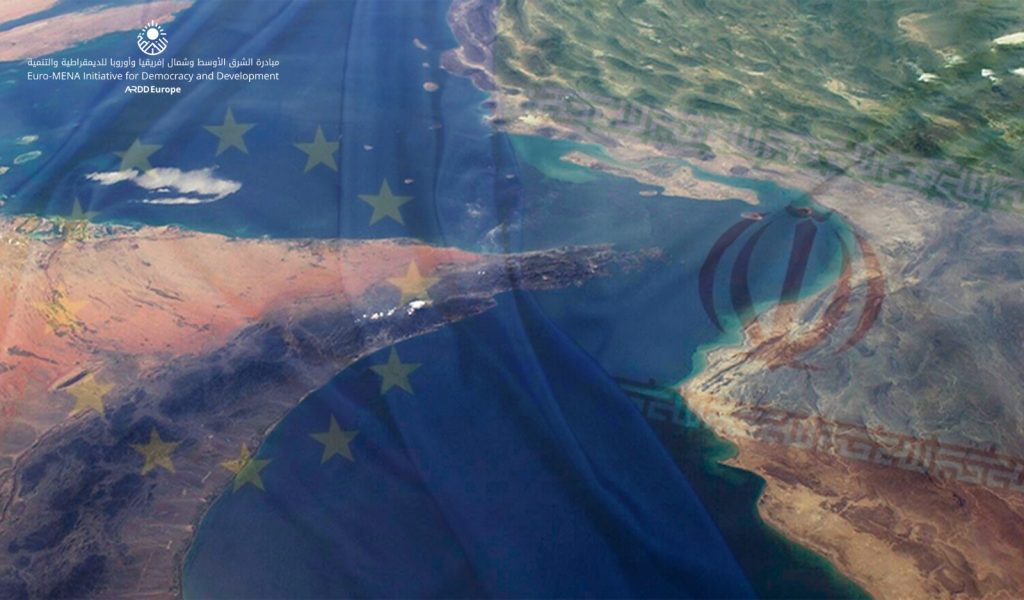
Over the past decade, the European Union (EU) has gradually shifted toward a more security-oriented foreign policy, shaped by successive crises including the Syrian war, migration pressures, and Russia’s invasion of Ukraine. Against this backdrop, the escalation of the 2026 Iran war has further accelerated this ongoing transformation, prompting EU policymakers to refocus on regional stability, energy and maritime security, and non-proliferation (Politics Today, 2024).
This evolution raises a central question: to what extent is the EU still primarily acting mainly as a promoter of norms and values, or is it increasingly becoming a more conventional geopolitical and security actor?
From normative power to a strategic and security actor
The EU has long been conceptualized as a “normative power”, shaping international relations through values such as peace, liberty, the rule of law, democracy, human rights, and good governance (Manners, 2002; Manners, 2008). However, the 2026 Iran war marks a critical acceleration in the gradual erosion of this self-image, as it has forced the EU to confront a high-intensity geopolitical crisis that directly affects European security, energy markets, and regional stability (EU Council, 2026; EEAS, 2024).
Unlike previous crises, the Iran War has not remained geographically distant: it has disrupted maritime routes, increased energy volatility, and intensified fears of regional spillover into Europe’s neighborhood, thereby directly embedding EU interests in the conflict dynamics. In response, the EU expanded maritime security operations in the Red Sea to protect commercial shipping and energy routes, while simultaneously deepening energy partnerships with Egypt and Eastern Mediterranean states to diversify gas supplies and reduce strategic dependency. The EU has also intensified migration containment cooperation with countries such as Egypt and Tunisia, increasingly prioritizing border management and regional stabilization over governance conditionality. In this context, EU external action has shifted rapidly toward crisis containment, maritime security, energy diversification, migration management, and closer coordination with transatlantic partners, often as urgent reactive measures rather than value-driven initiatives.
This shift does not simply represent a policy adjustment but signals a deeper transformation: the EU is increasingly acting as a security actor in practice, even as it continues to frame its external action in normative terms. The Iran war thus acts as a catalyst that exposes and accelerates an underlying trend: the gradual prioritization of geopolitical resilience over normative conditionality in EU external relations.
The tensions exposed by the Iran War are not entirely new. EU engagement in the Middle East has long reflected an uneasy balance between normative commitments and geopolitical considerations, particularly in relation to Israel and regional security dynamics. While the EU has consistently supported international law, the two-state solution, and multilateral diplomacy, critics have frequently pointed to gaps between European normative discourse and the limited political consequences attached to violations of international law in practice. The current regional escalation, therefore, reinforces pre-existing debates regarding the consistency of EU external action and the limits of normative power under conditions of geopolitical crisis.
Case studies: Lessons from EU–Egypt Cooperation
A useful way to understand how the Iran war may reshape EU external action is to examine the recent evolution of EU–Egypt relations. In 2024, the EU elevated its partnership with Egypt into a “Strategic and Comprehensive Partnership,” accompanied by a €7.4 billion financial package aimed at macroeconomic stabilization, energy cooperation, migration management, and security cooperation (European Council, 2024 ; European Commission 2024). While formally presented as a broad partnership, its operational focus increasingly reflects European priorities linked to energy security and regional stability rather than governance reform.
This reorientation is particularly visible in the EU’s growing emphasis on Egypt as a key energy and geopolitical partner in the Mediterranean, especially in the context of European efforts to diversify gas supplies following the war in Ukraine (International Energy Agency, 2024). Although the EU continues to reference shared values and long-term development objectives, public documentation of the partnership places stronger emphasis on resilience, stability, and investment mobilization than on political conditionality (EEAS, 2024; Council of the EU, 2024).
This case is particularly useful for understanding the potential trajectory of EU engagement in the context of the Iran war. It illustrates how external shocks linked to regional instability can accelerate a reordering of EU priorities, where security imperatives as energy diversification, migration control, and geopolitical risk reduction, become dominant framing logics. The Egypt case, therefore, reflects a broader regional trend in which EU engagement increasingly prioritizes resilience, energy security, migration control, and geopolitical risk management alongside and at times above traditional normative conditionality.
Beyond the security – values binary
However, framing the EU’s evolution as a simple trade-off between security and human rights risks oversimplifying a more complex transformation. The European Union continues to define human rights, democracy, equality, and non-discrimination as core principles of its external action, explicitly linking these values to peace, regional stability, and long-term security (European External Action Service, 2024). In this sense, the EU still seeks to portray itself as a reliable partner and defender of the rules-based international order, even within an increasingly fragmented geopolitical environment.
This continuity can be better understood through the concept of ontological security, which refers to the need of political actors to maintain a coherent and stable sense of identity over time (Mitzen, 2006). For the EU, promoting norms abroad has historically not only served diplomatic purposes but also reinforced its own identity as a normative and rules-based actor. As security concerns linked to the Iran war increasingly shape EU external action, ontological security helps explain why normative language remains central to EU discourse even as policy priorities become more focused on stability, resilience, and geopolitical risk management.
Policy implications
- The EU should formalize differentiated conditionality frameworks, recognizing that uniform governance standards are increasingly difficult to sustain across diverse geopolitical contexts.
- Major security and energy agreements should include publicly available human rights impact assessments to improve transparency and accountability.
- Civil society support should be structurally protected from short-term stabilization priorities, as long-term resilience depends on robust non-state institutional ecosystems.
- EU–MENA cooperation should evolve toward co-defined security frameworks that integrate economic and social dimensions of security, not only military or energy concerns.
Reference List :
Carnegie Endowment for International Peace. (2026, March). The EU needs a third way in Iran.
https://carnegieendowment.org/europe/strategic-europe/2026/03/the-eu-needs-a-third-way-in-iran
Council of the European Union. (2024, January 23). 10th EU–Egypt Association Council meeting: Joint press statement.
https://www.consilium.europa.eu/en/press/press-releases/2024/01/23/10th-eu-egypt-association-council-meeting-joint-press-statement-by-egypt-and-the-european-union/
Council of the European Union. (2026, March 1). Statement by the High Representative on behalf of the European Union on developments in the Middle East.
https://www.consilium.europa.eu/en/press/press-releases/2026/03/01/statement-by-the-high-representative-on-behalf-of-the-european-union-on-developments-in-the-middle-east/
European External Action Service. (n.d.). EU–Egypt relations.
https://www.eeas.europa.eu/node/15687_en
European External Action Service. (n.d.). North Africa, Middle East and Gulf – Egypt.
https://north-africa-middle-east-gulf.ec.europa.eu/countries/egypt_en
European Union Agency. (2024). EU–Egypt strategic partnership (press release). European Commission.
https://ec.europa.eu/commission/presscorner/detail/en/ip_24_1503
International Energy Agency. (2024). World Energy Outlook 2024.
https://www.iea.org/reports/world-energy-outlook-2024
Manners, I. (2008). The normative ethics of the European Union. International Affairs, 84(1), 45–60. https://doi.org/10.1111/j.1468-2346.2008.00688.x
Manners, I. (2002). Normative Power Europe: a contradiction in terms? JCMS Journal of Common Market Studies, 40(2), 235–258. https://doi.org/10.1111/1468-5965.00353
Mitzen, J. (2006). Ontological Security in world Politics: State identity and the security dilemma. European Journal of International Relations, 12(3), 341–370. https://doi.org/10.1177/1354066106067346
Politics Today. (2024). How does the Iran War transform Europe and transatlantic relations?
https://politicstoday.org/how-does-the-iran-war-transform-europe-and-transatlantic-relations/