By Margaux de Foy
Recent changes in civil society dynamics and geopolitical engagement throughout the Middle East and North Africa (MENA) region have highlighted the importance of local governance structures and their capacity to create societies that are more inclusive and resilient. There is a growing interest in bolstering subnational institutions as a supplement to national policy frameworks in light of climate concerns, changing international assistance environments, and developing regional dialogues. These trends pose significant concerns about how the European Union (EU) and its MENA partners should collaborate to assist community-level involvement and conflict management in ways that respect local agency and prevent perceptions of external imposition.
A Complex Governance Landscape
The majority of governments in the MENA area still have highly centralized governance, with national authorities in charge of important choices and resource flows. Although centralization might provide a cohesive direction, it frequently restricts local councils’ and municipal governments’ ability to address particular community needs. While national decision-making is still predominant in certain nations, such as Egypt and many Gulf states, reforms have attempted to give local councils greater power in others, like Morocco and Tunisia. Formal governance systems may be poor or disjointed in governments impacted by violence or instability, such as Libya, Yemen, or parts of Syria. This leads to hybrid arrangements where informal authorities and community networks cover institutional gaps.
This diverse setting demonstrates why the discussion on local government is both topical and vital. Local governance may improve responsiveness to community needs, increase citizen engagement, and act as a vehicle for resolving conflicts before they escalate. In situations when national institutions fail to maintain legitimacy or reach all constituents, strengthened local entities might provide more realistic alternatives for discourse, issue solving, and service delivery.
Local Governance as Part of Euro‑MENA Engagement
The EU’s engagement with MENA countries has generally focused on high-level cooperation frameworks, like as the European Neighborhood Policy and broader development projects spanning trade, migration, climate, and security. In recent years, this engagement has broadened to include support for institutional capacity building and community-level programming, as seen in programs such as Baladiyati, an EU-funded initiative in Libya that collaborated with ministries and municipal authorities on local governance projects across 21 municipalities.. UNICEF
Such projects demonstrate a significant shift: extending beyond national policy discussions to include municipal and community actors who are actively involved in governance on the ground. These efforts are part of a larger trend in international collaboration, where local and regional authorities are increasingly recognized as strategic partners in addressing complex challenges, such as climate resilience, public service delivery, and social cohesion. OECD
At the same time, the regional context demonstrates why a “one size fits all” model of governance export is not feasible nor desirable. The MENA region’s complexity, from centralized monarchies to fragile governments with conflicting powers, necessitates specific, context-driven methods that respect local customs and institutional histories.
Civil Society, Women’s Leadership, and Conflict Dynamics
Parallel to governance improvements, civil society players in the MENA area are becoming more visible in shaping community outcomes. This is especially clear in debates about peacebuilding and inclusiveness. Global frameworks like the Women, Peace, and Security (WPS) agenda emphasize the need for inclusive engagement in conflict prevention and resolution, highlighting that peace agreements and governance processes are more sustainable when they incorporate various voices. ONU Femmes
In 2025, regional efforts such as the Women, Peace, and Security Working Group in Doha attempted to create more coherent policy frameworks across the Arab States for implementing the WPS agenda, signaling a growing institutional recognition that localized peacebuilding must partner with regional diplomacy. Middle East Council on Global Affairs
Meanwhile, the EU’s “Together for Peace” campaign in Yemen emphasizes how peacebuilding initiatives may bridge national commitments and community-level engagement, demonstrating that peace work frequently happens outside of formal negotiations, rooted instead in everyday citizen participation. SEAE
These trends reflect a larger reality: governance and peacebuilding are inextricably linked. Local governance processes that incorporate civil society, particularly women’s groups, can provide outlets for dispute resolution, social discussion, and inclusive decision-making that contribute to long-term stability.
Implications for Euro‑MENA Partnership
The changing landscape of governance in the MENA area has various consequences for EU participation and regional civil society.
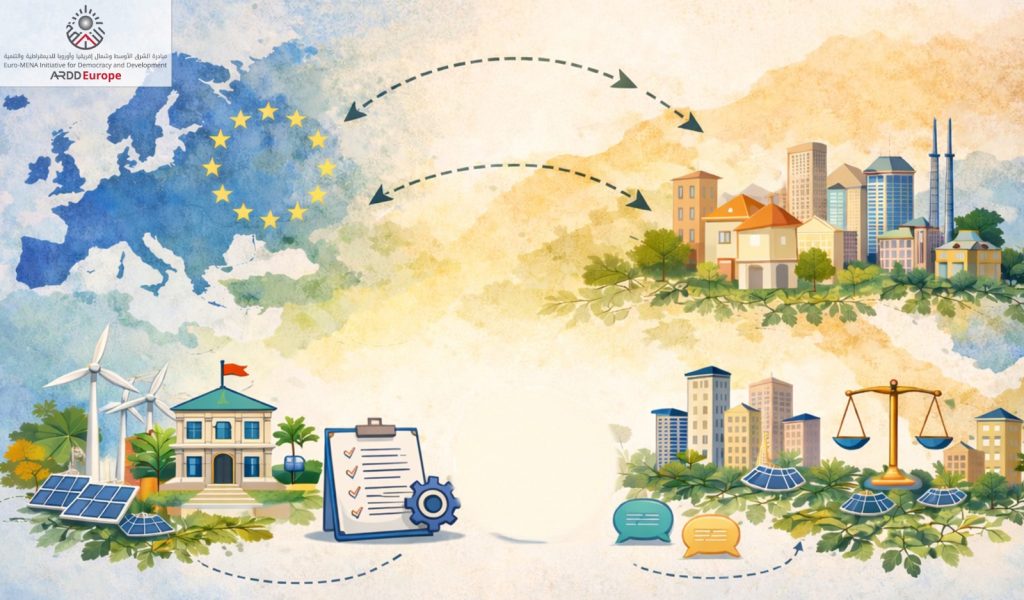
Firstly, it calls on Euro-MENA collaboration to go beyond state-centric paradigms and invest in multilevel governance, which involves regional and municipal authorities. Supporting municipal capacity and civic participation can boost trust in institutions and improve service delivery, thereby closing gaps that lead to societal discontent or instability.
Secondly, such interaction must be contextually appropriate and locally owned. External players, particularly the EU, should refrain from tactics that may be perceived as prescriptive or neocolonial. Instead, they must collaborate with local stakeholders, while respecting cultural norms and existing decision-making mechanisms, to co-design governance support that complements national aims.
Ultimately, supporting civil society and inclusive governance mechanisms, such as those focused on gender justice and peacebuilding, can help reinforce the broader social contract. Engaging women’s organizations, youth networks, and community groups in addition to formal institutions provides diverse viewpoints on addressing societal concerns, increasing the validity and sustainability of outcomes.
Recommendations
To translate these principles into practice, several pathways could be pursued:
- Expand multi-level cooperation frameworks that link national, regional, and local actors on shared priorities such as climate adaptation, service delivery, and conflict prevention.
- Invest in capacity building for local authorities and municipal institutions, providing technical support and peer-to-peer exchanges that strengthen administrative competencies and governance practices.
- Partner with civil society networks, including women’s organizations and grassroots movements, to ensure that governance reforms are inclusive and responsive to community needs.
- Encourage local peacebuilding initiatives that connect institutional actors with informal networks, enabling more flexible, culturally grounded approaches to conflict resolution.
By centering local governance within Euro‑MENA partnerships and grounding these efforts in collaboration rather than imposition, there is potential not only to enhance governance effectiveness but also to contribute to more resilient and peaceful societies across the region.